Plenty of apps begin as a voice memo recorded late at night: an idea that would make someone’s day a little easier. By morning, the idea still feels exciting, and a new question appears. Who can turn this into something people can download?
A mobile app development company in Michigan can answer that question and guide you from a rough concept to a polished app on the Apple App Store and Google Play.
For businesses in Livonia, Detroit, and across Michigan, developing a mobile app is an opportunity to improve customer experiences, simplify everyday operations, and create new ways to grow.
This guide follows the questions first-time app owners ask most, with practical answers to help you move from your initial idea to a successful app launch.
Where Should I Start With My App Idea?
Start with the problem you want to solve. Write one sentence that says, “My app helps [who] do [what] more easily.”
A fitness studio near Livonia might write, “My app helps members book classes in two taps.” That sentence becomes your compass for every decision that follows.
Next, list the three things a user must be able to do on day one. Everything else can wait for a later version.
For example, a local service business might need an app that allows customers to:
- Book appointments without calling.
- Receive reminders and service updates.
- Make secure payments through their phones.
A short feature list keeps the project focused, helps control development costs, and makes the first launch more manageable.
Before contacting a mobile app development company, consider researching similar applications. Identify what they do well, where customers experience difficulties, and how your idea could offer something better.
Should I Build for iPhone, Android, or Both?
Your customers should influence this decision. Check your website analytics, ask existing customers, or study which mobile devices your target audience uses.
There are three common approaches to mobile application development.
Native Mobile Apps
Native applications are developed separately for iOS and Android using platform-specific technologies.
They offer extensive access to device features and are often suitable for performance-intensive applications, advanced graphics, and projects requiring deep operating system integration.
Cross-Platform Mobile Apps
Cross-platform applications use a shared codebase to support both iOS and Android.
Technologies such as React Native and Flutter allow developers to build applications for multiple platforms while reusing much of the development work.
This approach can reduce development time and maintenance costs for many business applications.
Progressive Web Apps
Progressive web apps run through mobile browsers and can offer features such as home-screen installation and offline functionality.
They can be useful for testing an idea or serving customers without requiring a traditional app store download.
However, some device features and platform capabilities may be more limited than those available in native applications.
Businesses already using React for their websites may find React Native a practical option. Working with a React development company that understands both web and mobile technologies can help maintain consistent interfaces and simplify selected parts of the development process.
The right platform ultimately depends on your target audience, required features, budget, and long-term business goals.
What Is an MVP, and Why Do People Recommend One?
MVP stands for Minimum Viable Product. It refers to an initial version of your application containing the essential features needed to deliver value to early users.
Imagine a Livonia restaurant planning a mobile ordering application.
Its first version might include:
- A digital menu displaying available items.
- A simple ordering process.
- Secure online payment.
- Pickup confirmations and notifications.
Features such as loyalty rewards, gift cards, advanced personalization, and scheduled ordering could arrive in future updates.
An MVP offers three important advantages.
Faster launch: By concentrating on essential functions, development teams can prepare an initial release sooner.
Early customer feedback: Real users can help identify which features are useful and which need improvement.
Better budget management: Businesses can prioritize development investments based on actual customer behavior rather than assumptions.
Starting small does not mean sacrificing quality. A successful MVP should still be secure, functional, easy to navigate, and capable of solving the main customer problem.
What Happens During Mobile App Development?
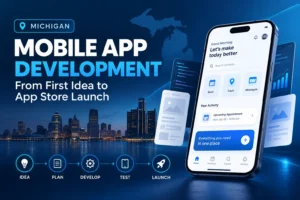
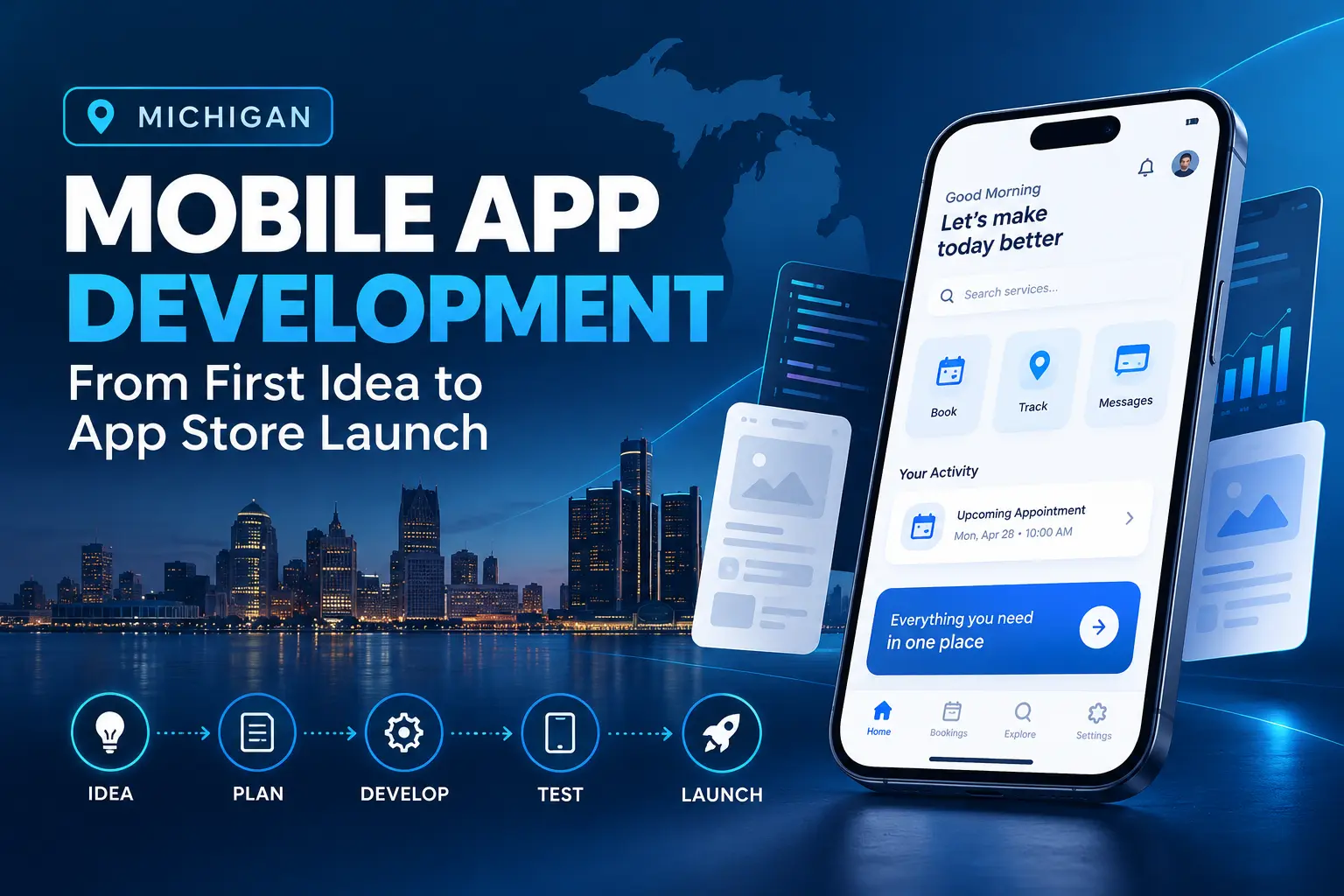
A well-organized mobile application development project follows a structured process from planning to launch.
1. Discovery and Strategy
The development team begins by understanding your business, customers, competitors, and application goals.
This stage helps define the project’s scope, technical requirements, budget expectations, and priorities.
2. Wireframes and User Flow
Wireframes are simple layouts showing how application screens will be organized.
They help everyone understand how users will move between features before detailed visual design begins.
3. UI and UX Design
User interface (UI) design focuses on the appearance of the application, including colors, typography, icons, and layouts.
User experience (UX) design focuses on usability, navigation, accessibility, and how easily customers complete tasks.
Both are important for creating an application people enjoy using.
4. Development in Sprints
Developers build the application through smaller work cycles, commonly called sprints.
Each cycle focuses on specific features, allowing businesses to review progress and provide feedback throughout development.
5. Testing and Quality Assurance
Before launch, the application is tested across supported devices, screen sizes, operating system versions, and network conditions.
Testing may include:
- Functional testing
- Performance testing
- Security testing
- Usability testing
- Compatibility testing
These checks help identify problems before customers encounter them.
6. App Store Submission and Launch
Once development and testing are complete, the application is prepared for submission to the Apple App Store and Google Play.
Each platform has technical requirements, content policies, and review processes.
Approval times vary, so businesses should allow time for possible revisions.
7. Maintenance and Updates
Mobile app development continues after launch.
Developers monitor performance, resolve bugs, improve security, and introduce new features as customer needs evolve.
A focused first version may take a few months to develop, although timelines depend on complexity, integrations, approval processes, and project requirements.
How Much Does Mobile App Development Cost in Michigan?
Mobile app development costs vary depending on the project’s size, technical requirements, and complexity.
A relatively simple application with a limited number of screens generally requires less development effort than an application with live tracking, complex user accounts, payment processing, and administrative dashboards.
Several factors influence the final budget.
Platform requirements: Developing for one operating system may require different resources than supporting both iOS and Android.
Design complexity: Custom animations, complex navigation, and highly personalized interfaces can increase development effort.
Feature requirements: Payments, GPS tracking, messaging, notifications, and third-party integrations require additional development and testing.
Backend infrastructure: Applications that store customer information, process transactions, or synchronize data often require databases, APIs, and server-side systems.
Ongoing maintenance: Hosting, monitoring, security updates, and software improvements create expenses after the initial launch.
Before hiring a mobile app development company in Michigan, request a written project scope and a phased cost estimate.
Breaking development into clear milestones helps businesses track spending, prioritize features, and make informed decisions.
Will My Mobile App Need a Website Too?
For most business applications, having a website is highly beneficial.
Potential customers frequently search online before installing an unfamiliar application. A dedicated website or landing page can explain the app’s features, benefits, pricing, and availability.
It also provides a central location for important information, such as:
- Privacy policies and support information.
- Application features and screenshots.
- Download links for iOS and Android.
- Frequently asked questions.
- Contact details and customer support.
Depending on the app’s features and store requirements, additional disclosures or account-management information may also be necessary.
A coordinated website and mobile application help maintain consistent branding and communication.
For Michigan businesses, a search-optimized website can also introduce the application to people searching for relevant services in Livonia, Detroit, and surrounding communities.
How Will People Find My App After Launch?
Building an excellent application is only part of the process. Businesses also need a plan to attract downloads and encourage ongoing engagement.
Optimize Your App Store Listing
App Store Optimization (ASO) helps improve how applications are presented and discovered within app marketplaces.
Important elements include:
- A clear and recognizable application name.
- An accurate description explaining its benefits.
- Professional screenshots highlighting key features.
- Relevant keywords where supported by the platform.
- Regular updates and genuine customer feedback.
Promote the App Through Your Website
Create a dedicated landing page explaining the application’s purpose and linking directly to the appropriate app stores.
Relevant website content can introduce potential customers to the application before they decide to download it.
Use Social Media and Email Marketing
Businesses can announce their application through social media posts, short demonstrations, newsletters, and customer announcements.
Showing how the app solves a specific problem often communicates more value than simply announcing that it is available.
Consider Local Digital Marketing
For businesses operating in Michigan, local marketing campaigns can help reach customers in specific cities or service areas.
Depending on the audience, a strategy may include Google Ads, social media advertising, search engine optimization, and local business outreach.
Encourage Genuine Reviews
Ask customers who have used the application to share honest feedback.
Authentic reviews help prospective users understand real experiences and provide useful insights for improving the application.
A coordinated launch strategy makes it easier to introduce your app to the right audience.
How Should I Keep My App Healthy Over Time?
Mobile applications require ongoing attention.
Apple and Google regularly update their operating systems, policies, and development requirements. Applications may need updates to maintain compatibility and meet current platform standards.
A practical maintenance strategy should include several important activities.
Performance monitoring: Track crashes, loading times, and technical errors to identify issues affecting the customer experience.
Security updates: Maintain secure authentication, encrypted connections, updated dependencies, and responsible data-handling practices.
User feedback: Review customer suggestions and identify recurring problems that need attention.
Analytics monitoring: Understand which features customers use most, where they abandon tasks, and what improvements could increase engagement.
Feature improvements: Introduce new capabilities based on customer demand, business priorities, and application performance.
Monthly performance reviews can help businesses plan improvements before minor technical problems become serious obstacles.
What Should I Look for in a Mobile App Development Partner?
Choosing the right development partner is an important business decision.
A reliable mobile app development company should demonstrate technical knowledge while explaining the process in language you can understand.
Consider the following factors when evaluating potential partners:
- Relevant experience: Review previous projects and ask whether the team has developed applications with similar requirements.
- Portfolio quality: Explore available applications and evaluate their usability, design, and performance.
- Clear communication: Choose a team that provides understandable explanations and regular project updates.
- Transparent project scope: Request written details about deliverables, development milestones, timelines, and payment terms.
- Code and account ownership: Clarify ownership, intellectual property rights, and access to repositories, hosting, and app store accounts.
- Testing procedures: Ask how the team identifies bugs, evaluates security, and tests applications before launch.
- Post-launch support: Understand what maintenance, bug fixes, and future updates are included.
A good development partnership should feel collaborative.
Your understanding of your customers, combined with the development team’s technical expertise, helps create an application that supports real business goals.
Why Choose a Michigan-Based Mobile App Development Company?
Working with a Michigan-based development team can offer advantages for businesses that value local market familiarity and accessible communication.
A team familiar with Michigan’s business environment may better understand the needs of local restaurants, healthcare providers, retailers, professional service companies, and growing startups.
Local collaboration can also simplify communication when discussing customer expectations, regional business challenges, and project goals.
However, location alone should not determine your decision.
Technical expertise, transparent processes, relevant experience, security practices, and long-term support are equally important.
The ideal partner combines an understanding of your business with the ability to deliver an application that performs reliably and provides lasting value.
How We Work at Code Nexa
Code Nexa is a Michigan-based development and digital services team supporting businesses locally and across the United States.
Our approach brings strategy, design, development, and digital marketing together to help businesses create connected digital experiences.
Instead of treating an application as an isolated project, we consider how it fits into your broader business goals, website, customer experience, and future growth plans.
Every project begins with a discussion about your idea, target audience, essential features, and expected outcomes.
From there, we work toward a practical development roadmap that outlines priorities and helps establish clear expectations.
Whether you want to launch your first business application or improve an existing digital product, our mobile app development services in Michigan focus on turning business requirements into practical, user-friendly solutions.
Frequently Asked Questions About Mobile App Development in Michigan
How long does it take to develop a mobile app?
A straightforward mobile application may take a few months, while complex applications can require considerably longer. Development time depends on design requirements, integrations, platform support, testing, and requested features.
Is React Native a good choice for business applications?
React Native can be a suitable option for many business applications because it supports iOS and Android development using a shared codebase. The final technology choice should depend on the application’s features, performance requirements, and long-term plans.
Can I launch an app with a limited budget?
Yes. Starting with an MVP allows you to focus on essential features and introduce additional functionality over time. A phased development approach can make project costs easier to manage.
Do I need separate developers for iOS and Android?
Not necessarily. Cross-platform technologies such as React Native and Flutter allow developers to share much of the code between iOS and Android. Some projects may still require platform-specific development.
Who owns the application after development?
Ownership depends on the terms of your development agreement. Before signing a contract, confirm who owns the source code, design assets, app store accounts, and associated intellectual property.
Does an app need maintenance after launch?
Yes. Regular maintenance helps maintain compatibility with operating system updates, address security issues, fix bugs, and improve application performance.
Can a Michigan app development company work with businesses outside the state?
Yes. Mobile development projects can be managed remotely through planning meetings, shared project-management tools, demonstrations, and regular communication.
Ready to Turn Your Mobile App Idea Into Reality?
Every successful application begins with a clear problem, a practical plan, and a development team capable of bringing the solution to life.
Whether you are a startup exploring your first MVP or an established Michigan business looking to improve customer experiences, careful planning and the right technical approach can make the development process more effective.
From initial discovery and interface design to development, testing, app store submission, and ongoing improvements, each stage contributes to creating an application customers can confidently use.
If you are ready to explore your idea, contact Code Nexa to book a strategy call and discuss how your business can move from its first concept to a mobile application available to customers.
Build with a clear purpose, launch with confidence, and keep improving with every customer interaction.